Project:
Fifteen Game
Project Overview:
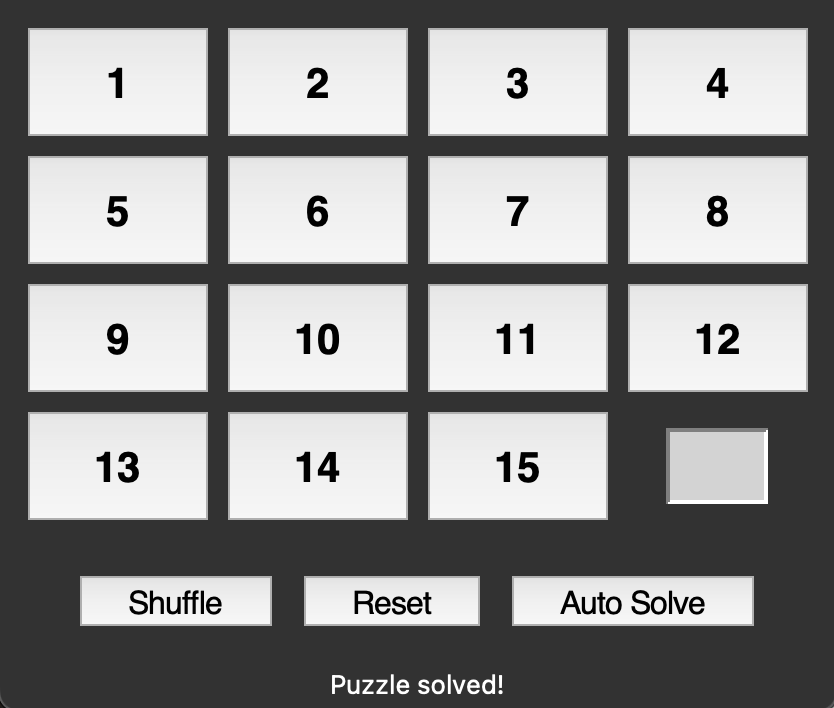
This project implements a fully functional Fifteen Puzzle game with an interactive GUI. It extends the classic sliding puzzle by incorporating graph data structures and search algorithms. The implementation includes a complete game model with proper state management, move validation, shuffle functionality, and solution verification, all integrated with a clean, user-friendly interface built with Tkinter.
Scope of work:
- Game Logic Implementation: The project creates a comprehensive model for the Fifteen Puzzle using NumPy arrays to represent and manipulate the game board. The implementation includes methods for validating moves, updating the board state, shuffling tiles, and checking if the puzzle is solved, demonstrating strong object-oriented design principles and algorithmic thinking.
- Graph Data Structure Implementation: A custom graph data structure is implemented with vertices, edges, and comprehensive traversal algorithms. The graph module provides both Breadth-First Search (BFS) and Depth-First Search (DFS) capabilities, showcasing knowledge of fundamental computer science concepts and their practical applications.
- GUI Development with Tkinter: The project features a polished graphical user interface built with Python's Tkinter library. The interface includes interactive tile buttons that respond to user clicks, control buttons for game actions (shuffle, reset, solve), and visual feedback that helps players track their progress, demonstrating front-end development skills and attention to user experience.
- Visual Step-by-Step Solver: The auto-solve functionality provides a visual demonstration of the solution process, moving tiles one by one with appropriate delays to allow users to follow along. This feature combines algorithmic problem-solving with effective visualization techniques to create an educational component within the game.
- Move Validation and Game State Management: The implementation carefully handles game state, including tracking valid moves, tile positions, and the empty space location. The code ensures that only legal moves are executed and provides appropriate feedback to the user, showing attention to detail and robust application design.
- Integration of Multiple Components: The project successfully integrates the core game logic, graph algorithms, and GUI components into a cohesive application. This integration demonstrates the ability to work with multiple modules and create clean interfaces between different parts of a software system
.
Key Takeaways:
- The Fifteen Puzzle implementation showcases mastery of fundamental programming concepts including data structures, algorithms, object-oriented design, and GUI development.
- The graph module provides a reusable implementation of graph data structures and traversal algorithms that could be applied to other problem domains.
- The visual step-by-step solver offers an intuitive way to understand how the puzzle can be solved systematically, enhancing the educational value of the game.
- The clean separation of concerns between game logic, graph implementations, and UI components demonstrates good software engineering practices and modular design.
- The project successfully combines mathematical concepts, computer science fundamentals, and interactive design to create an engaging user experience.


